
Why Do Businesses Need Static IP Addresses? Applications and Key Benefits
Why Do Businesses Need Static IP Addresses? Applications and Key Benefits
 November 10.2026
In business network operations, IP addresses are essential not only for connecting devices to the internet but also for remote access, server deployment, and network access management. Unlike rotating IP addresses, which may change over time, static IP addresses remain consistent, providing businesses with more stable and manageable network connections. So, why do businesses need static IP addresses, and what advantages do they offer?
Key Takeaways
· Stable Network Access: Fixed IP addresses make it easier to connect to business servers and internal systems remotely.
· Simplified Access Management: They facilitate IP whitelisting, firewall configuration, and access control.
· Support for Long-Term Operations: They are suitable for server deployment, account management, and multi-region business operations.
What Is a Static IP Address?
A static IP address is an IP address assigned to a network device or server that typically remains unchanged over time. Businesses can configure static IP addresses through their internet service providers or network administrators, allowing specific devices to use the same IP address consistently.
In contrast, rotating IP addresses are usually assigned automatically by a DHCP server and may change when a network reconnects or an IP lease is renewed.
Static IP addresses offer clear advantages for businesses that require consistent network connections, fixed access points, or stable network identities.
Why Do Businesses Need Static IP Addresses?
(1) Easier Remote Access and Management
Employees may need to access internal company servers, office devices, or business systems from different locations. A static IP address provides a consistent access point for remote connections, reducing the need to update connection settings whenever an IP address changes.
(2) Simplified Network Access Management
Many business systems use IP whitelisting to restrict access to authorized sources. Fixed IP addresses make it easier for administrators to configure access rules, firewall policies, and authentication requirements, reducing the management effort associated with frequently updating IP configurations.
(3) Support for Server and Business System Deployment
Business websites, email servers, databases, and other online applications often require consistent network access points. Static IP addresses simplify DNS configuration, server access rules, and third-party service authorization, helping maintain consistent business connectivity.
(4) Support for Long-Term Account and Multi-Region Operations
Businesses that manage long-term accounts, operate on regional platforms, or conduct localized operations may benefit from maintaining consistent IP addresses. This helps reduce the management issues associated with frequently changing network endpoints.
Static IP vs. Rotating IP: What Are the Differences?
Static and rotating IP addresses serve different purposes. Businesses should choose between them based on their actual networking requirements.
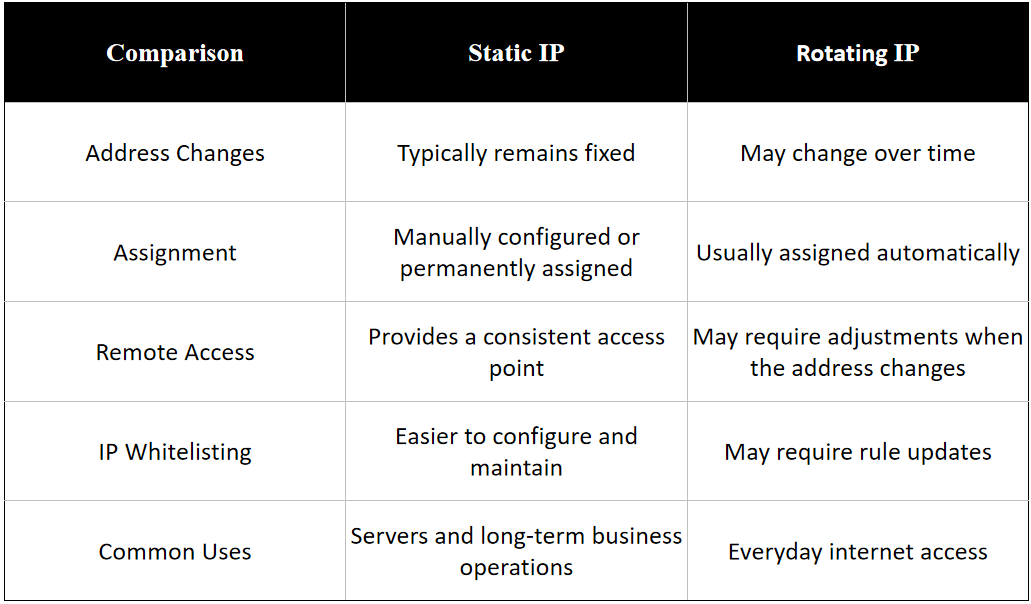
If a business requires a consistent access point over an extended period, a static IP is generally more suitable. For ordinary internet browsing and routine network connections, a dynamic IP is often sufficient.
How Can IPPeak Static Residential Proxies Meet Business IP Needs?
For businesses that require fixed residential network connections, consistent IP addresses, and access to IP resources across different regions, static residential proxies are another option alongside traditional ISP-provided static IP addresses.
IPPeak Static Residential Proxies (ISP Proxies) are designed for business scenarios that require long-term access to fixed residential IPs. By combining residential ISP network characteristics with fixed IP resources, IPPeak provides businesses with a flexible proxy solution.
Key advantages include:
· Dedicated Fixed Residential IPs: IPPeak provides native residential IP resources, with each IP individually assigned rather than shared. This makes them suitable for long-term account management and ongoing business operations.
· Unlimited Traffic: Plans come with no traffic limits, eliminating the need to constantly monitor data consumption and making long-term proxy cost planning easier.
· Multi-Region IP Resources: Coverage across 30+ regions allows businesses to select IP addresses based on their target markets and regional access requirements.
· Flexible Usage Periods: 30-day and 90-day plans are available, with usage periods of up to 90 days. This is suitable for businesses that need to maintain consistent IP identities over longer periods.
· Protocol Compatibility: HTTP and SOCKS5 protocols are supported, making integration with different browsers, software applications, and business tools easier.
For businesses managing multiple accounts, operating regional e-commerce stores, conducting market research, or maintaining consistent network connections, IPPeak Static Residential Proxies provide dedicated IP resources that are stable and easy to manage.
Businesses can select the required number of IPs, target regions, and usage periods according to their operational needs, reducing the management burden associated with frequently changing IP addresses.
FAQ
Q1: Does a static IP address improve internet speed?
Not necessarily. Static IP addresses primarily improve address consistency and access management. Actual network speed depends on factors such as bandwidth, network routing quality, and connection conditions.
Q2: Are static IP addresses always better than rotating IP addresses for businesses?
No. Static IP addresses are more suitable for server deployment, remote access, and long-term account management, while rotating IP addresses are generally sufficient for everyday internet access.
Q3: What is the difference between a static residential IP and a regular static IP?
A static residential IP typically has residential ISP network characteristics while maintaining a fixed IP address. Regular static IP addresses may come from datacenter or other network resources, depending on the provider.
Conclusion
Static IP addresses help businesses simplify remote access, network access management, and long-term operations. They provide a convenient solution for business applications that require consistent network endpoints.
For businesses that also need residential network characteristics, dedicated IP resources, unlimited traffic, and multi-region coverage, IPPeak Static Residential Proxies (ISP Proxies) are another option worth considering. Choosing the right IP resources based on business requirements can improve network management efficiency and support reliable long-term operations.
You might also enjoy
Why Do Businesses Need Static IP Addresses? Applications and Key Benefits
Discover why businesses use static IPs and how IPPeak static residential proxies support stable network access.
November 10.2026
What Is a Static Residential IP? How Is It Different from a Regular Static IP?
Static residential IPs combine fixed addresses with genuine residential networks for stable, long-term business use.
November 10.2026

How Residential Proxies Support Ad Fraud Detection: A Guide to Cross-Regional Ad Verification
Learn how residential proxies support cross-regional ad verification and help detect suspicious advertising traffic.
November 10.2026


© Copyright 2026 ippeak.com. All rights reserved.


