
How to Improve Node.js Web Scraping Efficiency with Proxy IP Rotation
How to Improve Node.js Web Scraping Efficiency with Proxy IP Rotation
 November 11.2026
Node.js is widely used for web scraping because its asynchronous, non-blocking I/O model allows it to handle multiple network requests simultaneously. However, when scraping tasks send continuous requests to the same website, they may encounter rate limits, temporarily unavailable IPs, connection timeouts, and other issues. These problems can increase request failure rates and extend the time required to complete scraping tasks.
Proxy IP rotation allows scraping requests to be sent through different IP addresses, reducing reliance on a single IP. With a properly configured rotation strategy, it can also improve request distribution, connection stability, and resource utilization.
Key Takeaways
· Distribute Request Traffic: Use proxy IP rotation to distribute requests and reduce excessive traffic from a single IP address.
· Manage Sessions Effectively: Choose between IP rotation and sticky sessions based on scraping requirements to balance request efficiency and connection stability.
· Choose the Right Proxy: Consider IP quality, geographic coverage, and connection speed. For example, IPPeak Premium Residential Proxies cover 195+ countries and regions and offer a 99.5% connection success rate.
Why Does Node.js Web Scraping Require Proxy IP Rotation?
Node.js can handle multiple network requests simultaneously, but its processing capabilities do not mean that target websites allow unlimited access. When a large number of requests come from the same IP address, a website may identify the traffic as unusual and impose access restrictions.
Common challenges include:
(1) Too Many Requests from a Single IP
When multiple scraping tasks share the same IP address, request volume can increase rapidly within a short period. This may trigger access restrictions or temporarily prevent further data collection.
(2) Failed Requests Slow Down the Entire Process
If a proxy IP experiences connection issues or access restrictions, related requests may fail. The scraping program may need to retry requests or wait for connections to recover, increasing overall processing time.
(3) Limited Access to Location-Specific Data
Some websites display different content based on the geographic location of the visitor's IP address. Using an IP from only one region may not be sufficient for collecting and comparing data across multiple locations.
Proxy IP rotation helps distribute requests across different IP addresses and select network resources based on the target location, reducing dependence on a single IP.
How Does Proxy IP Rotation Improve Web Scraping Efficiency?
Proxy IP rotation is more than simply changing IP addresses. It involves distributing network requests according to the requirements of different scraping tasks.
It can improve efficiency in three main ways:
(1) Distribute Requests to Reduce Pressure on Individual IPs
Assigning different requests to multiple IP addresses prevents all traffic from being concentrated on a single network exit. However, using more IPs does not automatically guarantee better performance. Request frequency and the target website's access policies must also be considered.
(2) Replace IPs When Connection Issues Occur
When an IP encounters connection failures or response timeouts, the system can determine whether the issue requires an IP change and retry the request when appropriate. This helps reduce the impact of problematic connections on the overall scraping process.
(3) Balance IP Rotation with Session Stability
Not every scraping task benefits from frequent IP changes. For example, tasks that require login authentication or continuous access to the same page may experience session interruptions if the IP changes too frequently.
In these cases, sticky sessions can maintain the same IP address for a specified period. For independent requests, rotating IPs may be a more suitable approach.
How to Develop an Effective IP Rotation Strategy
Different scraping tasks have different requirements for IP stability and rotation frequency. The following strategies can be selected according to specific needs:
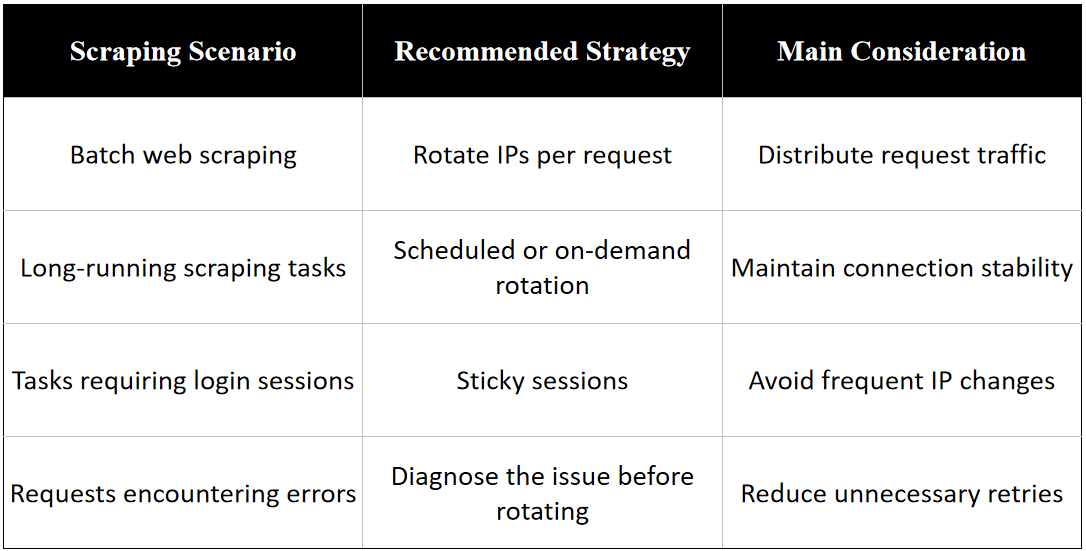
In addition, consider the following factors:
· Control Concurrent Requests: Avoid sending too many requests within a short period.
· Set Reasonable Retry Policies: Retry temporary network errors when appropriate and avoid endless repeated requests.
· Monitor IP Availability: Regularly check connection status and replace unavailable IPs when necessary.
An effective rotation strategy should be based on actual scraping requirements rather than simply aiming for the highest possible IP rotation frequency.
How to Choose the Right Proxy for Node.js Web Scraping
In addition to rotation strategies, proxy resource quality also affects scraping performance. When choosing a proxy service, consider IP pool size, geographic coverage, connection success rate, protocol compatibility, and pricing.
For scraping tasks that require multi-region access and flexible IP rotation, IPPeak Premium Residential Proxies offer a suitable combination of residential IP resources and session management capabilities.
· Extensive IP Resources: Access an optimized pool of 80M+ residential IPs across 195+ countries and regions.
· Precise Geographic Targeting: Supports targeting by country, state/province, city, and ASN to collect data from different locations.
· Flexible Connection Options: Supports both IP rotation and sticky sessions to accommodate different scraping requirements.
· Stable Connections: Offers a 99.5% connection success rate and response times of less than 0.5 seconds.
· Broad Protocol Compatibility: Supports HTTP and SOCKS5, unlimited concurrent sessions, and non-expiring plans.
IPPeak Premium Residential Proxies start at $0.60/GB, with a first-purchase offer of 50% off the 5GB plan for just $9.90. For standard scraping tasks where cost efficiency is a priority, IPPeak Core Residential Proxies start at $0.49/GB.
Frequently Asked Questions
Q1: How many proxy IPs are needed for Node.js web scraping?
There is no fixed number. It depends on request volume, concurrency, and the target website's access policies. Focus on maintaining IP quality and distributing requests properly rather than simply increasing the number of IPs.
Q2: Does more frequent proxy IP rotation improve scraping efficiency?
Not necessarily. Frequent IP changes may affect login status and session continuity. IP rotation works well for independent requests, while sticky sessions are generally more suitable for tasks that require persistent connections.
Q3: Are residential proxies suitable for Node.js web scraping?
Yes. Residential proxies are suitable for scraping tasks that require multi-region IP resources, flexible rotation, and stable connections. When choosing a service, consider IP pool size, connection performance, and budget.
Conclusion
Improving Node.js web scraping efficiency requires more than simply distributing requests. It also involves choosing an appropriate IP rotation strategy based on the requirements of each scraping task. By managing concurrency, handling connection issues promptly, and selecting residential proxies with broad geographic coverage and reliable connections, businesses can reduce unnecessary delays while balancing scraping performance and operating costs.
You might also enjoy
How to Fix Proxy Connection Issues in n8n: Common Causes and Solutions
Learn how to troubleshoot n8n proxy connection issues, fix authentication and timeout errors, and choose reliable residential proxies for automated workflows.
November 11.2026
How to Improve Node.js Web Scraping Efficiency with Proxy IP Rotation
Learn how proxy IP rotation improves Node.js web scraping efficiency through better request distribution, session management, and reliable residential proxies.
November 11.2026
MTProto vs. SOCKS5: Which Proxy Is Better for Telegram?
Compare MTProto and SOCKS5 for Telegram, explore their differences, and discover how IPPeak residential proxies offer flexible SOCKS5 connections.
November 11.2026


© Copyright 2026 ippeak.com. All rights reserved.


